
If you struggle with sugar cravings, the idea of intuitive eating can sound absolutely terrifying. “You want me to stop restricting sugar? Won’t I just binge on it?”
I understand the fear. If sugar already feels like a food you can barely control yourself around, giving yourself unconditional permission to eat it can feel like removing the only guardrail you have.
Maybe you like the idea of intuitive eating. You want to stop obsessing over food. You want to eat when you’re hungry and actually stop when you’re full. But when it comes to sugar, something in you pumps the brakes.
Other people might be able to keep cookies in the house. I can’t.
If I let myself eat whatever I want, I’ll eat sugar all day.
Maybe intuitive eating works for normal eaters, but not for someone like me.
I used to feel this way too. I meticulously counted grams of sugar, tried to choose the “healthier” option, and still found myself overeating sweets later.
Restriction was miserable, but it also felt necessary. I assumed that without it, things would get even worse. Therefore, we can’t talk about intuitive eating and sugar without addressing the elephant in the room:
Does reducing restriction around sugar make people lose control?
If I Stop Restricting Sugar, Won’t I Binge More?
This is one of the most common fears around intuitive eating, and fortunately, we have research that gets surprisingly close to answering it.
In a randomized controlled trial, researchers recruited 403 people, about 90% of whom were already binge eating at least once a week.
Instead of teaching participants to exert more control over food, the intervention specifically worked on reducing dietary restraint. Participants practiced things like eating more regularly, challenging rigid food rules, and gradually reintroducing foods they had feared or forbidden themselves from eating.
The result? The group taught to reduce dietary restraint had greater reductions in objective binge-eating episodes than the control group, and the improvements were maintained at an eight-week follow-up.[1]
That doesn’t prove that restriction causes every binge or that simply giving yourself permission to eat whatever you want will magically eliminate compulsive eating.
But it does challenge an assumption that keeps many people trapped:
Reducing restraint did not open the floodgates, and binge eating actually decreased.
But What About Intuitive Eating Specifically?
There’s another recent study that looked specifically at intuitive eating.
In a 2025 randomized controlled trial, researchers taught intuitive eating skills to 248 people who were already struggling with recurrent binge eating. Compared with a waitlist group, participants improved in intuitive eating (that part might be obvious) and overall eating-disorder symptoms (that’s the part worth noticing).[2]
This wasn’t specifically a sugar study, and the findings don’t allow us to say that intuitive eating eliminated binge eating. But I find the larger point reassuring:
People who were already vulnerable to binge eating were taught to loosen rigid control and eat more intuitively, and their broader relationship with food improved rather than deteriorated.
If part of you worries that intuitive eating is fine for people who already have a peaceful relationship with food but dangerous for people who feel out of control, the evidence we have does not support that assumption.
But What If Sugar Really Is Addictive?
This is where the fear gets harder to shake.
Maybe you can imagine loosening your rules around bread or pasta, but sugar feels almost drug-like. You start eating it and immediately want more. You think about it when it isn’t around. You might even describe yourself as “addicted” to it.
I don’t think that experience should be dismissed.
In a 2023 human brain-imaging study, researchers found a shared neural pattern that predicted the intensity of both food cravings and drug cravings.[3] In other words, there really are similarities in how craving is experienced and processed by the brain.
So when someone says that sugar feels like a drug, there may be something very real underneath that description. But feeling similar does not necessarily mean working the same way.
The same research also found that food craving was not neurologically identical to drug addiction. There are important differences between responses to food and drugs.
And newer human research has challenged one of the most popular explanations for why sugar is supposedly addictive: the idea that hyperpalatable food (those rich in fat, salt, carbs, and/or sugar) causes an enormous dopamine surge comparable to addictive drugs.
In a 2025 experiment, researchers gave 50 adults an ultra-processed milkshake high in both sugar and fat and measured their dopamine response using brain-imaging methods commonly used in addiction research.
They did not detect a significant average dopamine increase after participants consumed the milkshake. The researchers concluded that the dopamine response was likely substantially smaller than what is seen with many addictive drugs.[4]
This was a sugar-and-fat milkshake, not pure sugar, and dopamine is only one piece of addiction. The study does not prove that addiction-like eating isn’t real. What it does challenge is the frightening oversimplification that “sugar hits your brain just like cocaine.” Your cravings can be powerful without sugar literally functioning like an addictive drug.
And even if your relationship with food feels genuinely addictive, there is another piece of research I find particularly important.
Even Addiction-Like Eating Doesn’t Necessarily Require Giving Up Problem Foods
When we believe a substance is addictive, cutting it out completely can seem like the obvious solution.
If alcohol makes someone lose control, they may need to stop drinking alcohol. If cigarettes are addictive, quitting cigarettes makes sense. Following that logic, if sugar feels addictive, perhaps you should never eat sugar again.
Except food presents a very different problem—and researchers are beginning to test whether people with addiction-like eating actually need to eliminate their problem foods completely in order to improve.
In a 2024 randomized controlled trial, researchers studied 175 adults experiencing multiple symptoms of addiction-like eating. The active treatment took a weight-neutral, harm-reduction approach that included regular eating, individualized coping strategies, problem-solving, and realistic goals. Participants were not required to completely abstain from their problem foods.
Compared with the control group, participants receiving the intervention were about five times more likely to achieve clinically meaningful improvement in addiction-like eating symptoms, with improvements still evident at the six-month follow-up.[5]
Studies like these offer real hope for people who fear they are too addicted to sugar for intuitive eating to work. And that hope doesn’t require minimizing how powerful those cravings can feel.
You can take addiction-like sugar cravings seriously without concluding that you need to ban sugar for life.
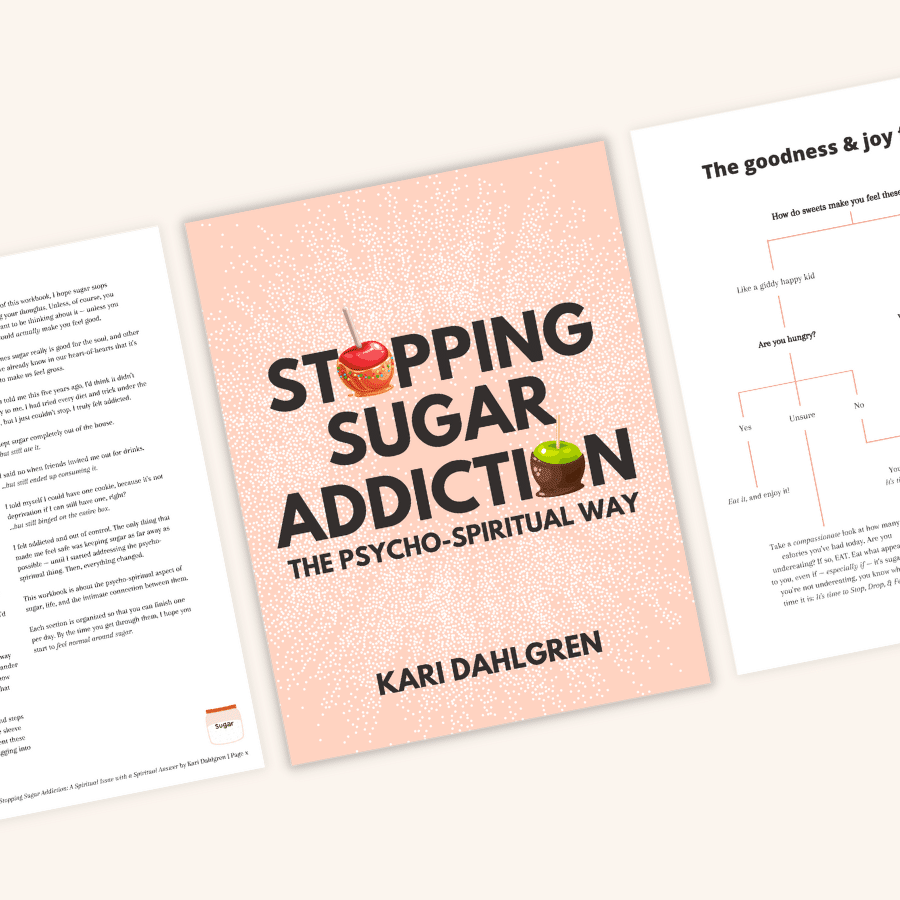
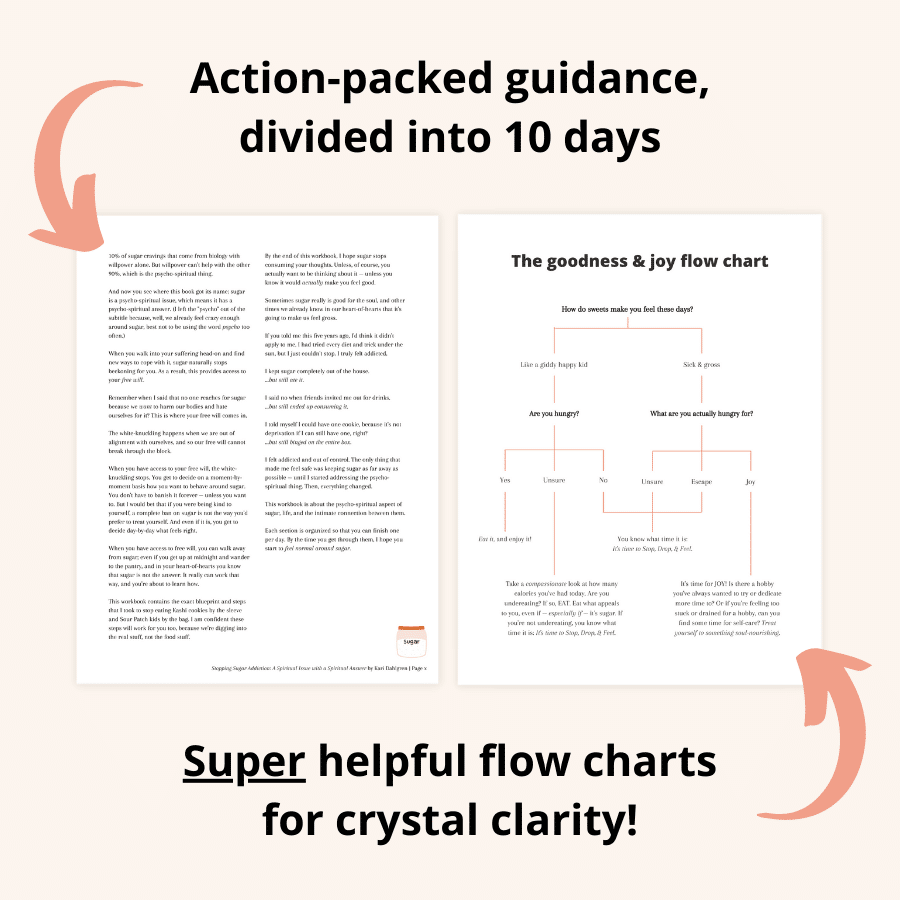
If you resonate with feeling genuinely addicted to sugar, this is exactly why I created my workbook, Stopping Sugar Addiction the Psycho-Spiritual Way. It validates how powerful and addiction-like sugar cravings can feel while giving you psycho-spiritual tools to navigate sugar without the need for restriction.
How to Cope with Sugar Cravings with an Intuitive Approach
Once sugar is no longer forbidden, you can get curious about what the craving is actually asking for. Are you hungry? Does sugar simply sound satisfying? Or are you physically full and reaching for food because something else is going on? And with the latter, we often have no idea until we really dig in.
Here are three ways to begin.
Step 1: Ask Yourself If You’re Physically Hungry
If you’re hungry, eat. That sounds simple, but years of dieting can train you to ignore, suppress, or postpone hunger. In reality, hunger is a simple signal that your body needs sustenance and it should have an equally simple answer: to eat. Diet culture has robbed us of that simple relationship with hunger, and intuitive eating gives us an opportunity to reclaim it.
If you’re hungry and sugar sounds good, you may simply be hungry, and you should be allowed to eat something you actually want. This doesn’t mean nutrition stops mattering.
Intuitive eating includes gentle nutrition, which means you can honor what sounds satisfying while also considering what would nourish you and help you feel good. The difference is that nutrition becomes information you can use, not another reason to forbid the food you actually want.
Step 2: If You’re Not Hungry Then Stop, Drop, & Feel
Now let’s say you want sugar, but when you check in with your body, you realize you aren’t physically hungry. This is where my approach adds another layer to intuitive eating.
In my own recovery from compulsive eating—and now in my work as an eating psychology coach—I’ve found that some of our strongest urges to eat without hunger can show up when there’s an uncomfortable feeling underneath the surface.
That’s why I developed the Stop, Drop, & Feel®.
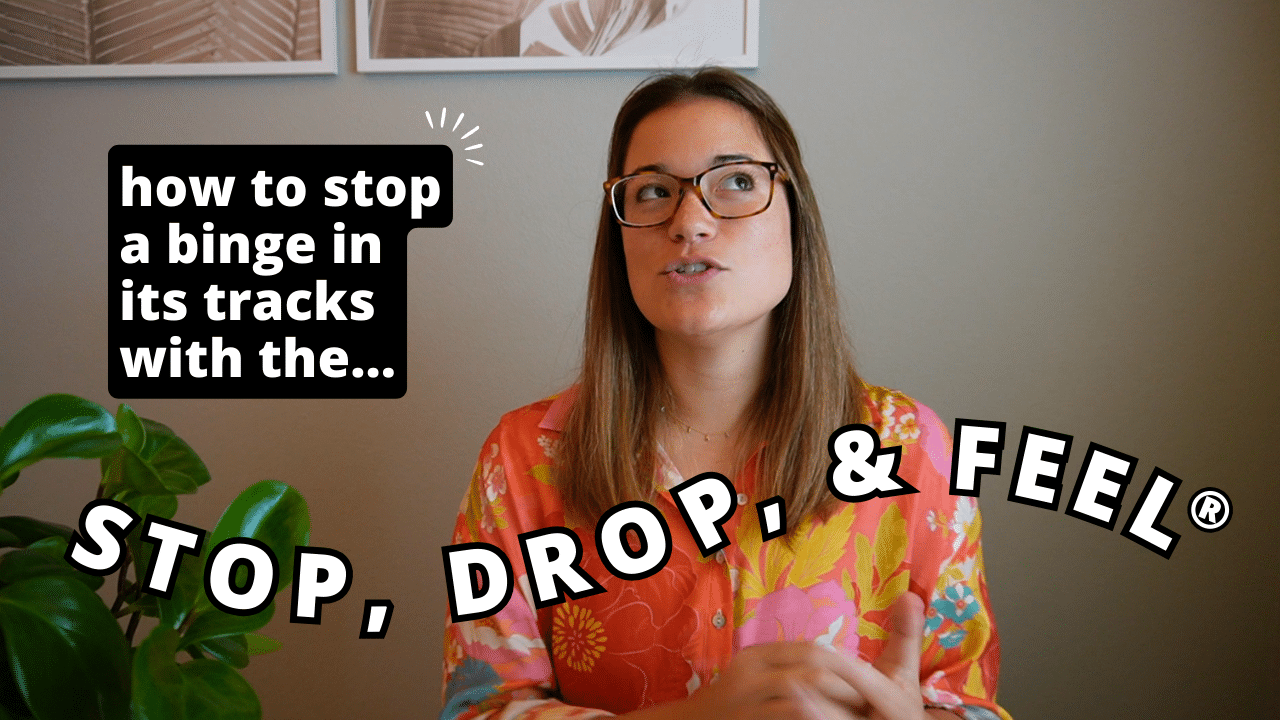
- Stop: Before reaching for sweets, pause for two minutes. Promise yourself that you still have permission to eat it afterward if that’s what you want.
- Drop: Step away from the food and drop your attention into your body. What are you feeling right now? Sometimes an emotion may pop up right away, sometimes it takes time, and sometimes nothing at all surfaces. That’s all okay.
- Feel: Instead of intellectualizing the feeling, practice sitting still with it, which can be much harder than it sounds. This is why it helps to use a timer, because you have a very clear indication of when this challenging practice is over.
The Stop, Drop, & Feel is not a trick for talking yourself out of eating sugar. That would just turn it into another form of restriction—and that is why the ‘stop’ involves promising yourself you can still have the sugar if that’s what you really want. You can’t skip the promise.
Sometimes the Stop, Drop, & Feel creates enough space for an uncomfortable emotion to come bubbling forward. When you practice sitting still with discomfort, you build emotional tolerance, a skill that I personally associate with reduced compulsive eating. I can’t speak for everyone, but I can speak from both personal experience and from helping others.
And if you finish those two minutes and still want the cookie? Eat the cookie. Often this still results in consuming less sugar overall because you aren’t also eating around the craving.
Step 3: Zoom Out and Make Sure You’re Eating Enough
There’s another important element worth checking, and it’s one that diet culture has long been training us to ignore: are you eating enough overall?
You can honor hunger in the moment and still be chronically underfed across the day. Maybe you are trying to lose weight by dieting, regularly skip breakfast, or consistently try to make your meals as light as possible. Then late afternoon rolls around and suddenly sugar feels impossible to stop thinking about.
There’s biology behind this too. Human research has found that energy restriction can increase ghrelin, a hormone involved in hunger, and that fasting can make high-energy foods more appealing.[6], [7]
If you’ve barely eaten all day and suddenly cannot stop thinking about brownies, I would not immediately assume there’s an emotion you need to process. You may simply need food.
Making Peace with Sugar
Trust me when I say, I understand exactly how terrifying it can be to let go of the restrictions around sugar and trust yourself again. I get it. Sugar can feel like something worse than Pringles: once you pop, you might literally never stop.
My hope is that some of your fears are quelled by the latest clinical research. Studies suggest that loosening rigid food restrictions—while learning a more balanced way of relating to food—can reduce binge eating and improve your relationship with food overall.
But again, knowing this is likely to work is one thing. But actually putting it into practice can feel overwhelming and scary. That messy space between understanding what you want to do and actually feeling safe enough to do it is where I can help.
My approach, Psycho-Spiritual Wellness, overlaps with intuitive eating, but the two aren’t identical. Intuitive eating offers a powerful framework for letting go of food rules and reconnecting with hunger, fullness, satisfaction, and gentle nutrition. My work focuses especially on those moments when you aren’t hungry but still feel compelled to eat.
If that’s the part of your relationship with food that feels hardest to untangle, my free resources below are the perfect next step.