
If you struggle with binge eating healthy foods, advice to “stop keeping junk food in the house” can feel a little ridiculous.
You already buy nutritious food. You know how to put together a healthy meal. And yet, once you start eating, you keep going back for more—and it can be incredibly frustrating.
The first thing I want you to check is whether you’ve eaten enough during the day, especially if you’re trying to lose weight. It’s easy to get so focused on eating healthy that eating enough gets overlooked. Then we can look at satisfaction, food rules, and what happens emotionally when you try to stop.
As an eating psychology coach and someone living in recovery from compulsive eating, I want to help you make sense of that moment when you know you want to stop eating and somehow find yourself reaching for more anyway—including when it’s healthy food.
Yes, It’s Possible to Binge on Healthy Foods, but Let’s Define ‘Binge’
Binge eating can involve everyday foods such as fruit, nuts, yogurt, or the leftovers from dinner. In a study of adults in Brazil with binge eating spectrum conditions, researchers found that episodes often included everyday foods such as rice and beans.[1]
But eating more than your diet allows doesn’t automatically mean you’ve had a binge.
Under DSM-5 criteria, a binge involves eating an unusually large amount of food for the circumstances within a limited period, while feeling unable to control your eating. Loss-of-control eating is a broader term: that feeling can also occur when the amount isn’t unusually large.[2]
For example, if you’re trying to stick to a weight loss diet of 1,200 calories a day (which is severe and far too common) and end up eating a substantial dinner plus snacks, you may feel as though you’ve eaten an unusually large amount. But exceeding that target doesn’t tell us whether you’ve eaten more than your body needs.
Restrictive food rules can influence what you perceive as overeating.[3]
In my work as a coach, I see people blame themselves for eating too much when they’ve been underfeeding themselves and catching up later. It’s important to look at that possibility before blaming yourself for having a lack of willpower.
Earlier restriction can also contribute to a genuine binge, so it doesn’t rule one out.[4] We need to consider both what you’ve eaten and how the episode felt, rather than judging it by a calorie limit alone.
Make Sure Healthy Eating Includes Enough Food
Perhaps you ate a big salad for lunch and felt proud of how healthy it was. By late afternoon, you’re picking at nuts, then cheese, then whatever else you can find. You wonder why you end up eating large amounts of food at dinner, after dinner, or late at night.
Before assuming it’s emotional eating, look back at breakfast and lunch. Was it enough to sustain you? Did you include foods that gave the meals some substance, or were you trying to fill up on vegetables while keeping everything else to a minimum?
If you’re trying to lose weight, eating less may be the whole point. A bigger breakfast or lunch can feel like giving up on the very thing you want. You may even be planning to make up for last night by eating less today.
I understand why eating more earlier can feel scary. You might worry that you’ll have the same evening of eating on top of those more substantial meals. If eating less during the day repeatedly leaves you ravenous at night, eating more earlier is worth trying—even when it feels like the last thing you should do.
Start with the meal you tend to shortchange.
That might mean adding some oatmeal if all you have for breakfast is coffee or adding a sandwich alongside a salad for lunch. Notice whether you arrive at dinner less urgently hungry when you’ve eaten more consistently beforehand.
You can still want to lose weight while recognizing that repeatedly getting through the day on too little food isn’t helping you feel normal around it.
And if your hunger cues feel confusing, you don’t have to wait for a perfectly clear stomach growl before feeding yourself. Eating regularly can help you notice when the urge to eat persists even after you’ve had enough food.
Notice When You Keep “Eating Around” What You Actually Want
Sometimes you want a cookie, but you have fruit instead. Then some yogurt. Then a handful of nuts. You’re getting fuller, and the cookie still sounds good.
Suddenly, it’s 10 p.m. and even though you’ve eaten more calories than you intended, you find yourself in the pantry eating cookies by the sleeve. This is a very common and exceptionally frustrating experience.
If you struggle with this restrict-binge cycle, try allowing the food you actually want to be part of your eating. You can put a cookie alongside your lunch without first working your way through several “healthy” substitutes.
Of course, sometimes you truly want the fruit or yogurt. That works too! The question is whether you’re choosing something you enjoy or bargaining with yourself because the food you want feels off-limits.
Feeling deprived can persist even when you have plenty of food available. You may have a well-stocked kitchen and still feel hemmed in by rules about what you’re allowed to eat.
A 2026 review found that restrictive diets were often associated with binge eating, particularly alongside difficult emotions.[4]
If you recognize a pattern of denying yourself food and then feeling increasingly preoccupied with it, that’s worth exploring. You can start with a food that feels less intimidating, such as allowing bread with lunch if loosening the rules around sweets still feels too scary.
Permission can feel scary when you don’t trust yourself around food. You don’t have to pretend otherwise, and you don’t have to tackle every fear food at once.
If you have medically necessary dietary restrictions, work within those needs while looking for food you enjoy. Giving yourself permission includes making room for satisfaction within the choices available to you.
I’m Full But Still Want to Eat Healthy Food—What Now?
What if you truly eat enough, enjoy the foods you actually like, but keep reaching for more healthy food even though you’re full? What then?
I know this experience personally.
In an earlier article about bingeing again, I wrote about being able to see what was happening while still struggling to stop. I called it “awareness hell.” Knowing what you’re doing while watching yourself do it can feel excruciating.
The good news is that there is awareness—even if it’s the frustrating kind—and with that awareness we can build the emotion-regulating skills necessary to address the root of emotional eating.
When we truly feel compelled to eat beyond fullness, I personally believe there’s an unwanted emotion lying beneath the surface that needs attention. When we sharpen our ability to identify and stay with those emotions, we have a better chance at stopping at fullness. While I speak from personal experience, clinical evidence also supports this idea.
In a randomized trial of 101 people with binge eating disorder, an emotion regulation program reduced binge episodes more than a waitlist, with benefits maintained at six months.[5] A 2026 review also found benefits from binge eating treatments that addressed emotions.[6]
So now the question isn’t what can I do, but how exactly do I work on my emotions to stop binge eating?
It Always Comes Back to the Stop, Drop, & Feel
My Stop, Drop, & Feel gives you a way to practice staying with uncomfortable emotions in the very moment you want to keep eating. Even if the SDF doesn’t stop a binge today, it lays important groundwork so that you have a better chance of stopping binge eating in the future.
Here’s how it works:
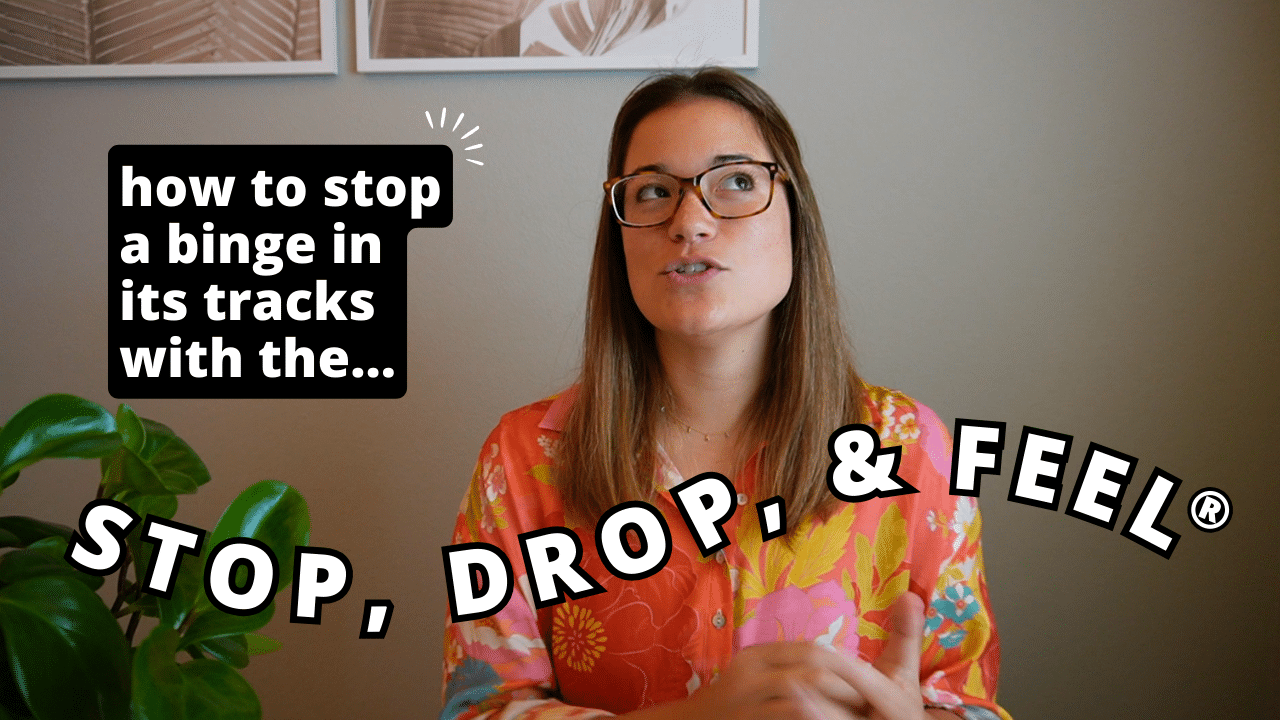
The next time that you feel the urge to eat beyond fullness:
- Stop: Pause and promise yourself that you can still eat what you’re craving afterward. This element of permission is crucial because it stops the SDF from becoming a form of restriction that would otherwise trigger the restrict-binge cycle.
- Drop: Sit or lie down somewhere you can have a little space, set a timer for two minutes, and drop into your body and your feelings. Ask yourself what you’re feeling.
- Feel: Let the feeling be there without requiring it to go away. Try not to intellectualize it or make sense of it. You don’t need a profound realization. Sometimes all you notice is, I really don’t want to sit here right now.
Sometimes the Stop, Drop, & Feel allows you to process your emotions enough that the desire to overeat genuinely fades away. Other times, it doesn’t produce a tangible result—but that doesn’t mean it isn’t working.
The SDF helps build the skills of emotional awareness and emotional tolerance, the ability to stay with discomfort without reaching for a buffer like food. Emotional tolerance takes time and repetition to build, so no matter the outcome of today’s SDF, rest assured that you’re building a skillset that can benefit you in the future.
Also, please don’t underestimate how difficult two minutes can feel. I’ve spent plenty of time starfished on my bed with emotions I very much wanted to avoid, wondering how two minutes could possibly take so long. You can understand the value of this practice and still struggle to sit through it. Sometimes sitting still with edginess takes everything you have.
Feeling Normal Around Healthy Food Again
If you keep binge eating healthy foods, I hope this helps you see a way forward that doesn’t depend on more food rules. You may need more substantial meals, more permission to eat foods you enjoy, or more practice staying with uncomfortable emotions. Several of these can be true at once.
Start with the part you recognize most clearly in your own eating. If you’re consistently underfeeding yourself, give yourself a chance to experience what eating enough feels like. If you’re adequately fed and still feel compelled to keep eating, start practicing the Stop, Drop, & Feel.
I know these changes can feel scary, especially when you’re afraid that eating more or loosening a food rule will make things worse. Give yourself time to work through that fear, too. There’s a lot of unlearning involved in this process, and you deserve patience while you practice.


Thank you so much for all your really helpful emails, I feel like you are the only person who speaks to me! I am not considered overweight in general but I am for me, and I am tte above, I only eat healthy foods but yes often compulsively.
I struggle with the concept of intuitive eating and the stop drop and feel, but I’m working on it!
Thanks so much for understanding that food issues are not all the same!
I am so happy my content resonates with you, Katie! And I can absolutely understand how intuitive eating and even the SDF are hard to put into practice. Letting go of food rules brings up all kinds of anxiety, which just piles on top of the emotions we’re already trying to deal with! I can speak for myself at least 🙂 My hope is that, by making the “goal” with the SDF just two minutes a day, it feels accessible enough to do, even if it’s a slog. Two minutes can feel like forever when you’re trying to sit still with edginess. So, kudos to you for working on it! Keep in touch and let me know how things progress. I am truly curious to hear more in the near future!