


Do you ever finish breakfast and immediately start thinking about lunch? This is a common, normal, and human experience. And yet, it can be quite frustrating to feel like you’re always thinking about food.
Maybe you wander into the kitchen, open the fridge, close it… open, close… walk away… and return ten minutes later without even knowing what you want.
Throughout the day, part of your mind is always engaged in food-related tug-of-war:
Those chips in the company snack room, I really want some, but I shouldn’t… Well, they are the small “snack size” after all. Maybe after I finish this next task I can have some. But I already had three bags yesterday…
This relentless mental chatter is sometimes called food noise. In a 2026 study of popular social-media videos about food noise, most people described the experience as negative or distressing.[1]
Thinking about food is not inherently a problem. It is normal to plan dinner, look forward to dessert, or notice that you are hungry. The problem is when food thoughts keep returning, feel difficult to turn down, and begin stealing your attention from the rest of your life.
If this sounds familiar, your first instinct may be to regain control: eat less, cut out tempting foods, track more carefully, or become more disciplined. Unfortunately, those efforts can make food even harder to stop thinking about.
Food Noise Usually Gets Louder for a Reason
Constant thoughts about food do not mean that you are weak, greedy, or lacking willpower. Usually, your body or mind is responding to some form of scarcity, deprivation, resistance, dissatisfaction, emotional association, or intense reward.
Understanding which forces are affecting you can make food noise feel much less mysterious and much easier to address. Let’s unpack these 6 common reasons for feeling like you’re always thinking about food.
1. Your Body May Not Be Getting Enough Food
When your body consistently receives less energy than it needs, thinking about food is simply one of the ways it motivates you to eat. This can happen during intentional weight loss, even if your diet looks perfectly reasonable on paper.
In one landmark study, people who lost weight through a low-calorie diet experienced increases in the hunger hormone ghrelin and decreases in leptin, which helps regulate appetite. Several of these changes were still present one year later.[2]
This shows how the body may respond to weight loss by turning up hunger and making food more difficult to ignore. Many people find themselves caught in the restrict-binge cycle because of this.
The classic Minnesota Starvation Experiment offers an extreme but revealing example. During World War II, 36 healthy men spent six months eating far less than their bodies required. As the restriction continued, food gradually took over their mental lives.
They collected recipes, read cookbooks for pleasure, talked constantly about food, and lost interest in many hobbies and activities they had previously enjoyed.[3]
They literally became obsessed with food.
You do not need to experience actual starvation for undereating to affect your mind. Skipping meals, stretching too long between meals, repeatedly ignoring hunger, or trying to survive on a calorie target that leaves you undernourished can all keep food mentally front and center.
2. Your Mind May Feel Deprived Even If You Are Eating Enough
Physical deprivation is not the only type that matters. You can eat enough calories and still feel psychologically deprived because the foods you truly want are restricted, controlled, or accompanied by guilt.
In a 14-day diary study of women who were dieting or binge eating, feelings of deprivation were not significantly related to how many calories they actually consumed. The researchers concluded that psychological deprivation can exist regardless of actual intake.[4]
This explains why a diet can keep food top of mind even when you appear to be eating “enough.” Perhaps you are technically allowed to eat bread, but only one slice. You can have dessert, but only after earning it.
You can eat whatever you want—as long as it fits your calorie target, your Points budget, or your definition of a “good” day.
Your stomach may be receiving food while your mind continues hearing, This is scarce. Be careful. You may not get this again. That sense of scarcity easily lends itself to feeling like you’re always thinking about food.
3. Trying Not to Think About Food Can Make It Louder
Have you ever decided that you were absolutely not going to eat a certain food (carbs and sugar are popular ones!) and then thought about it for the rest of the day? This is a common, normal, human experience.
Research suggests that trying to suppress thoughts about a prohibited food can make those thoughts more persistent.[5]
The harder you work to force a food out of your mind, the more attention you give it.
Then, when you eventually eat it, you may feel as though you have “lost control.” But the intense desire did not appear out of nowhere. It was often strengthened by hours, days, or years of resistance. This is why rigid food rules can create the very obsession they are meant to prevent.
Ready to overcome food obsession? Even if food noise feels loud, you already have a strength that can help you move forward. Take my 8-question quiz to discover your eating psychology strength.
4. Your Meals May Be Filling but Not Satisfying
Sometimes food noise persists because you have eaten enough volume but not enough of what genuinely appeals to you. You eat the sensible breakfast, the virtuous lunch, and the carefully portioned dinner.
Yet something still feels unfinished, and you end up eating late at night, or even in the middle of the night. Not only can this pattern cause enormous frustration, but it works against the body’s natural rhythm as metabolism naturally slows during the night.[6]
Sometimes the missing piece is satisfaction.
Satisfaction matters because eating is not purely mechanical. Flavor, texture, pleasure, variety, and enjoyment all help signal that an eating experience is complete. When those elements are repeatedly missing, you may keep searching for food even after your stomach is physically full.
This does not mean every meal must be spectacular. It means that consistently eating foods you dislike (like forcing a salad when you’re a warm foods kind of person), or avoiding the foods you truly want (like drinking a smoothie when what you really want is a lemon cookie), can keep your mind searching for more.
5. Some Foods Really Are More Rewarding
It would also be incomplete to pretend that every food affects appetite in exactly the same way. Hyperpalatable foods often combine refined carbohydrates, fat, sugar, or salt in ways that make them especially rewarding and easy to continue eating.
A 2025 review found that ultra-processed foods may influence appetite through a combination of intense palatability, faster eating, and reward-related processes in the brain.[7]
You may therefore notice that chips, cookies, candy, or other highly rewarding foods stay on your mind longer than plain oatmeal or steamed vegetables. But banning these foods often backfires.
When a rewarding food is also scarce, forbidden, or morally loaded, you combine its natural appeal with the psychological intensity of deprivation. The answer is not necessarily to avoid enjoyable foods forever. It is to remove the panic and urgency surrounding them so that they can gradually become ordinary.
6. Food May Have Become Connected with Emotion
Food thoughts can also appear because eating has become linked with certain emotional experiences. Perhaps anxiety makes you want something crunchy. Loneliness makes you want comfort food. Finishing a difficult day makes you want a reward in the form of food.
The emotion does not always have to be negative. Sometimes eating begins with happiness, celebration, or excitement, but stopping brings up sadness, disappointment, or a feeling that the enjoyable moment is ending too soon.
Over time, the emotional state itself begins triggering thoughts about food. This does not mean that eating emotionally is bad or that every celebration must be separated from food. The problem is when eating becomes such an automatic response that you no longer feel as though you have a choice.
How to Quiet Food Noise
Food noise rarely disappears because you find the perfect distraction or summon more willpower. It tends to quiet when you address what is making food feel urgent in the first place.
Eat Enough Before Expecting Yourself to Think Less About Food
Begin with the most basic question: Am I consistently eating enough? Notice whether you regularly skip meals, delay eating despite hunger, avoid carbohydrates, save calories for later, or end meals while still physically unsatisfied.
When you are hungry, eat.
When you are comfortably full, stop.
This sounds simple, but it becomes difficult when diet rules have trained you to distrust both signals. If you struggle to stop at fullness, it could be worth exploring what makes continuing to eat feel emotionally or psychologically compelling once physical hunger has passed.

Read this next: 9 Psychological Reasons for Overeating & How to Work With Them
Make Your Meals Actually Satisfying
A meal may contain enough food, yet still leave you searching for something else if it lacks flavor, variety, texture, or the foods you genuinely love.
Satisfaction helps signal that the eating experience is complete. When meals repeatedly feel bland, overly controlled, or disconnected from your preferences, your mind may keep returning to food even after your stomach is full.
Stop Turning Food Into an All-Day Math Problem
Tracking calories, macros, portions, or Points requires you to think about food repeatedly throughout the day. In one controlled study, calorie restriction increased cortisol (the stress hormone) output, while monitoring calories increased participants’ perceived stress.[8]
Even when you are not eating, part of your brain may be calculating what you have consumed, what remains available, and how to compensate tomorrow. Gradually unlearning the habit of calorie counting can create more space to notice your body instead.
Begin Trusting Internal Cues Again
Years of dieting or “watching what you eat” are common culprits of loud food noise. If you want to learn how to stop thinking about food, you may have to learn how to stop dieting as well.
This means getting back to basics: eat the foods that appeal to you when you’re hungry, stop when you’re full, and address your psychology if you ever feel compelled to eat past fullness.
Years of dieting can make hunger and fullness feel unreliable, frightening, or inconvenient. Rebuilding trust takes practice. For what it’s worth, the evidence gives intuitive eating the green light. A review of 20 interventions that encouraged eating based on internal cues found improvements in eating habits, body image, and psychological well-being.[9]
Food Can Become Quiet Again
If food occupies your mind all day, the answer is not more discipline. Your body may need more nourishment. Your meals may need more satisfaction. Your mind may need freedom from constant tracking and forbidden-food rules. Often, several of these forces overlap.
As you address them, food can slowly lose its urgency. A formerly forbidden food becomes ordinary. Hunger becomes a signal instead of an emergency.
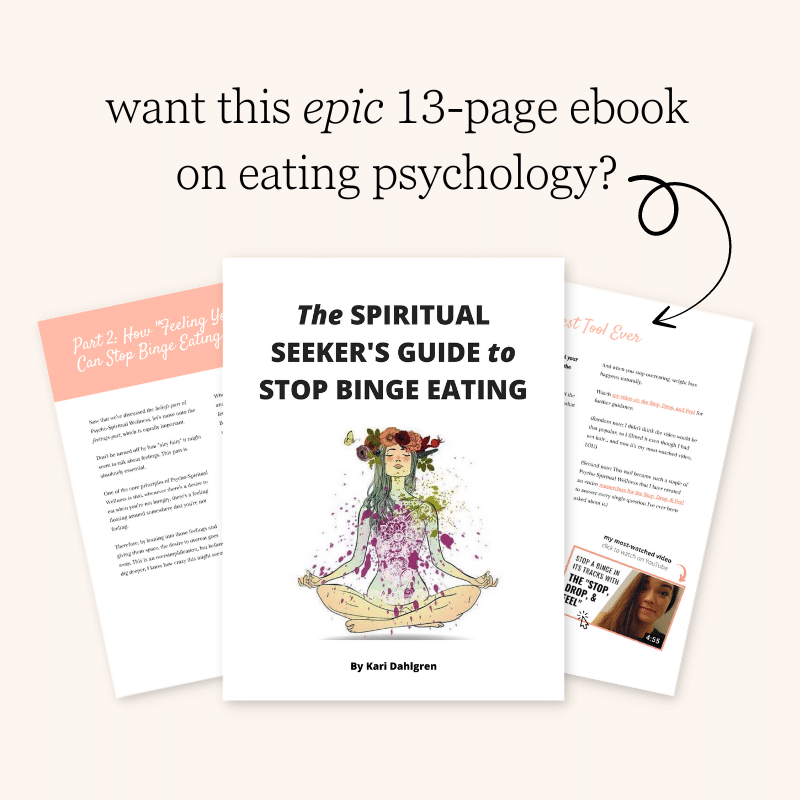
The goal is not to stop thinking about food altogether. The goal is to enjoy it, feel satisfied by it, and then have your mind become free to move on. If that feels like it would be nice for someone else but simply out of reach for you, I have some resources below that can help you out:


But if you’re trying to lose weight, which I have been by restricting and fasting and doing keto (all of which I have stopped, except the restricting), then how do you lose weight? I only know what has worked for me thus far. I’m trying to lose my last 20 lbs but I’m struggling ever since I stopped keto and fasting.
Hi Lea! This is a fair question and a great question. And you’ve inspired me to write a blog post specifically on that topic. In the meantime, I think you may find ‘set point weight theory’ relevant to your question. I wrote about that at length here: https://karidahlgren.net/set-point-weight/ Aside from that, I personally believe that weight loss naturally happens once compulsive eating is addressed, if the person is truly above their natural weight. The Stop, Drop, & Feel is the ideal tool to help with that: https://karidahlgren.net/stop-drop-feel/ If you keep an eye on the blog, you’ll see an article that expands on all of this soon. Thank you for asking a great question!
Hey Kari
Just want to say a big THANK YOU for your amazing blog posts and emails – they are helping me sooooooooo much and I’m sharing them with friends who, I know will benefit from them if they read them, so here’s hoping they do!
I’m 55 and after a lifetime of being big and dieting, I’m finally starting to feel like a normal person around food and it’s largely thanks to you and your blogs.
I lost just over 60lbs in 2022/23 and then started gaining it back (28 lbs) despite me thinking I was still doing the same things I had been doing (funny how your brain can convince you of that!). I’ve always been active with walking especially, and carried that on despite losing both our dogs in the last 2 years.
I was panicking at the very thought of trying to go back on specific plans again, and then, through research, I found you! I’m now finding I’m not interested in chocolate anymore, have naturally stopped being drawn to sweet things and I’ve been through stages 1 – 4 (of giving up dieting), so can totally relate to stage 2 and how scary that felt (chips and savoury crackers), but have come through the other side and am now starting to feel relaxed around all food and look forward to having what I WANT to eat rather than what I think I SHOULD be eating, and I listen for my ‘I’m full’ signals. Oh, and my weight gain is turning back around again too – slowly but surely!
My youngest daughter is at Uni studying psychology and this is giving us common ground for discussions too, so that’s another bonus! 😊
So, from the bottom of my heart, Thank you!
Caryn – England, UK
Hi Caryn! All the way from the UK, that is wonderful! Thank you so much for sharing your story. To know that you’re starting to feel normal around food again is music to my ears!! It’s why I do what I do! So, thank you for letting me know that all my efforts are worth it 🙂 You are so ambitious to take all these lessons and apply them and run with it. That takes true grit, as I’m sure you know since you’ve identified the stages of giving up dieting (oh how I loved reading that part). Congrats Caryn!! I hope to hear from you again sometime soon!