

When I was a teenager and young adult, I had severe acne. I am not embellishing my story when I say severe. I didn’t have 5 pimples on my forehead; I had 5 pimples per square inch.
It felt like the worst thing in the world at that time. After all, your face is where people look when they talk to you. My confidence was at rock bottom, and I couldn’t step out of the house unless I had makeup caked onto my face because, to me, cake-face felt better than red inflammation…
Severe acne actually followed me all the way through adulthood, eventually subsided into mild acne, and didn’t stop completely until I was about 28. I am very grateful. During that time between adolescence and young adulthood, when I would struggle with new breakouts that were hard to cover up, I would make a vow to myself that went something like this:
“When I have a day where I have no new pimples and smooth skin, I will be so happy. Even if I’m having a bad day, I’ll just look at my skin in the mirror and let that be enough.”
Have you ever made a similar promise with the shape of your body?
Trouble starts when we equate thinness with happiness
Have you ever made yourself a vow that if you can “just get your weight under control” then, even if you’re having a bad day, the way you’ll feel in your jeans will be enough?
I have definitely made those mental deals with myself. And if we were all in a room together, I’m sure that almost everyone’s hands would be raised—because we’re human.
Humans are wired to seek pleasure and avoid pain, and society has convinced us that thinness brings pleasure and happiness—and thinness is worthiness. It’s no wonder we want it so badly.
Today I want to share the different a-ha moments I’ve had in regards to weight, happiness, life, and everything in between since I gave up dieting in 2016. At the time, I was so fed up with gaining and losing the same 10 pounds that I was willing to set the number on the scale aside while I worked on my mental health.
At the time, I didn’t even know that giving up dieting was shown to help improve depression. I was just fed up with weight cycling (continuously gaining and losing weight, which is correlated with poor physical health) and wanted to see what would happen.
And a lot happened—all of it good, but not all of it happy, and I want to explain why even that is a good thing.
Here are some realizations that helped me make peace with my not-thin-but-oh-so-loveable body. If they resonate, I hope they will inspire you to give up dieting and listen to your body to inform what you eat, too.
Realization #1: Being able to see your clavicles might not lead to happiness
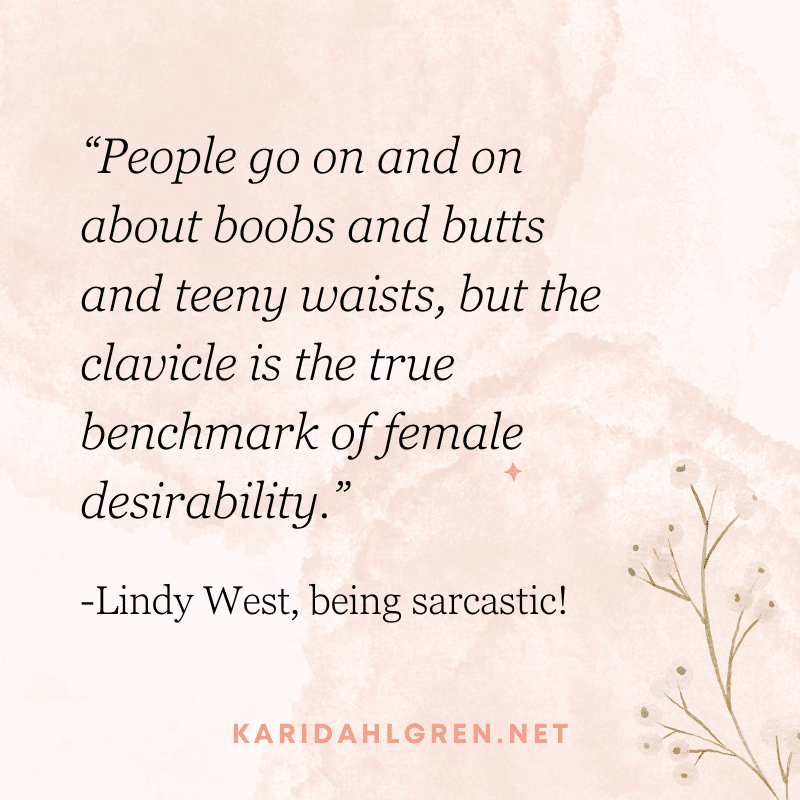
When I read the memoir Shrill by Lindy West, I found it so relatable when she talked about the desire to see your clavicles. As thick women, our clavicles don’t pop like they do on emaciated models, and when you see enough images of stick-thin models in magazines, you can’t help but equate clavicle-ness with happiness.
In our culture today, thinness has become a social currency. It “gets you” things, like free drinks and admiration (or so we think). I humbly admit that for a long time, I would have made a lot of sacrifices to be able to see my clavicles (or shoulder blades) pop. I thought that a more angular body would make me feel more confident.
Today, I am happy to report that it was only after giving up dieting that I had the thought: I’m not thin and I don’t know if I’ll ever be able to see my scapulae, but I’m still an amazing human being.
Then I had an even crazier revelation: I realized that I was never chasing a thin body. My real goal was the feeling that I thought a thin body would give me, which is love, acceptance, confidence, and approval.
Once I realized that I don’t need a thin body to achieve any of these feelings or states of being — which, hello, those phrases alone imply that you don’t need physicality to achieve it!—I felt immense relief. Almost like I was off the hook. Thank goodness! About time.
Realization #2: You can be thin and still feel crazy around food
I might sound ignorant saying this, but it never occurred to me that thin people could still have a poor relationship with food. I knew about body dysmorphia and eating disorders. However, I never stopped to think about how, with or without a clinically diagnosable problem, it’s possible to feel crazy around food no matter your shape and size.
You can even have popping clavicles and still feel miserable. I never thought of this! I just thought what many other people believe: that being thin solves all your problems.
Realization #3: Dieting might never work, and I can save myself a lot of struggling by simply letting go
![illustration of thinness/happiness cycle: drive for thinness & happiness = dieting [arrow to] dieting = overeating [arrow to] overeating = unhappiness & more dieting](https://karidahlgren-net.b-cdn.net/wp-content/uploads/2023/12/thinness-happiness-5.png)
Along those same lines, after I gave up dieting it finally occurred to me that I am saving myself a lot of struggling by surrendering the food rules. It may sound obvious, but I truly did not wrap my head around this until I started experiencing it for myself. (At the time, I did not even know at the time that dieting is linked to long-term weight gain, not weight loss!)
When I gave up dieting, I found myself experiencing less and less binges. I also found myself eating normal amounts of “bad foods,” which to me is a great improvement from binge eating “bad foods.” (These were my thoughts at the time. I have since stopped labelling food as “good or bad” for the sake of food neutrality and giving myself permission to eat the foods I love to continue to encourage intuitive eating.)
Realization #4: Life might not be easier once you’re thin
What do you assume about life at your natural weight? Do you assume that some things will be easier? If so, your beliefs might actually be a psychological block to weight loss. Because what if those things don’t actually happen? Or worse: what if weight loss actually brings a burden of its own?
In my work, I believe that people self-sabotage their weight loss efforts when they are somehow (often subconsciously) getting a greater positive benefit from struggling with weight than from being without the pattern. While this may sound preposterous, please allow me to share an example.
When I completed my own workbook on self-sabotage, Why We Do the Things We Do, I discovered that I believed a life without the weight struggle would involve more dates. I equated thinness with attractiveness and therefore copious dates. What I never realized, however, is that I also hate rejection—from either side. I hate being rejected, but I also hate being the rejector.
One of my psychological blocks to weight loss was protecting myself from upsetting other people—particularly through rejection. Although I hated feeling rejected, my desire to people-please was stronger.
Now, you may argue by saying, “But if you’re in a relationship, wouldn’t your partner desire you more if you were thinner? Or what if I really want to be thin? Wouldn’t that ‘positive benefit’ outweigh the desire to people-please?”
And to this I might say, sure that could be true. This was just one example from my own life. Your subconscious blocks to weight loss might be very different, and that’s why you need to do the work to dig them up.
Realization #5: You can’t be a people-pleaser and thin at the same time (at least, it’s much more difficult)
Speaking of people-pleasing, this is another unexpected burden of being thin; one that many of us don’t anticipate. Thin people do not receive love and approval from everyone. Have you ever heard a friend mutter the phrase skinny b*tch under her breath when someone thin walked by? Those comments are not silent.
And if you suddenly became thin, it means you need to withstand the heat of some people disliking you, sometimes even hating you, just because you’re thin.
And while that might not sound like such a bad trade off, because maybe you really want to be thin, I encourage you to think it through. You might feel this way now, but things are very different once you’re on the other side.
In order to reach your natural weight in the first place, you need to remove the buffer of overeating. You also need to start feeling your authentic discomfort instead of turning to food, which means you’ll start to feel your edginess more deeply.
Although you may assume that you’re capable of withstanding the heat now, the reality is that your emotional tolerance will be more strained once you’re at your natural weight because of the grit it takes to get there and stay there.
Realization #6: When you remove the problem of overeating, another problem will take its place—but that problem will be authentic
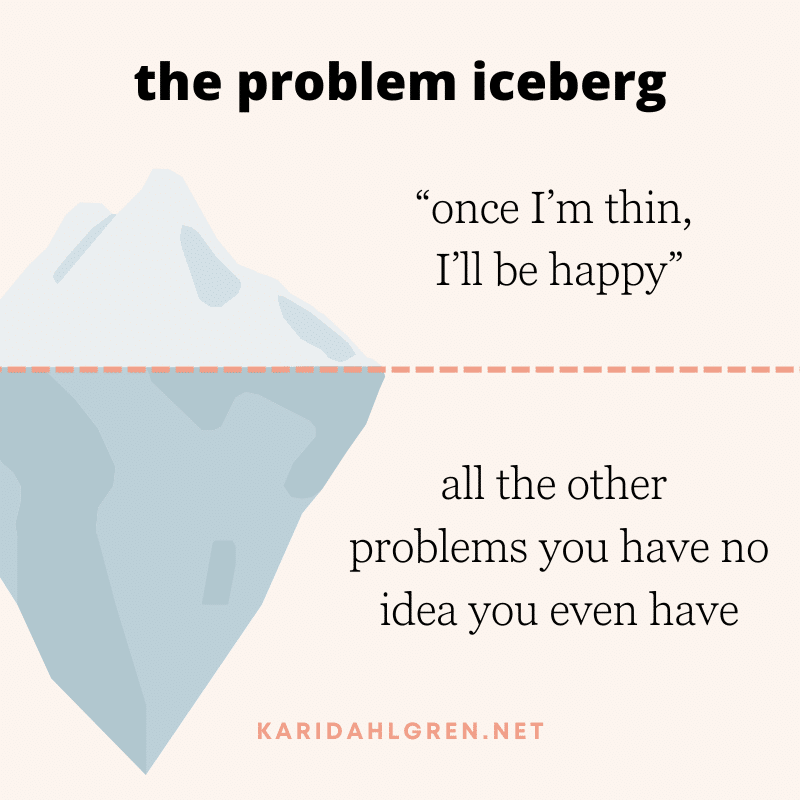
Another one of my greatest epiphanies was that life will always be full of problems. While that’s nothing new, I always thought that life without the food-problem would be full of much more insignificant problems, because I was convinced that nothing would be as challenging as feeling insecure about my body.
I was wrong.
While I am not thin, and I may never be thin, I do believe I’m at my natural weight, and the proportion of happiness to problems is roughly the same. However, my problems are far more authentic.
Dieting leads us nowhere. It’s a hamster wheel that keeps us stuck in the misery of weight cycling. And here enters one of the lovely benefits of giving up dieting: The problems I “progressed” onto actually took me somewhere new—somewhere better.
For example, I used to have a full-time job, and that job later became toxic. No matter how much I spoke up and tried to protect my boundaries and values, I was not met with respect. I spent six months battling it out with management and coworkers until I decided to quit and pursue my business full-time.
The depth of the struggle with that job was equivalent to the depth of my struggle with overeating. Both felt very painful; in different ways, yes, but the quantity of strife was roughly the same.
However, this struggle led me somewhere amazing: working for myself full-time. And while it’s much more vulnerable and comes with its own challenges, it’s the problem I prefer. In the paraphrased words of Mark Manson, “life will always be full of problems; the point is to choose the problems that you prefer.”
Realization #7: Life is truly 50/50, and this is good news
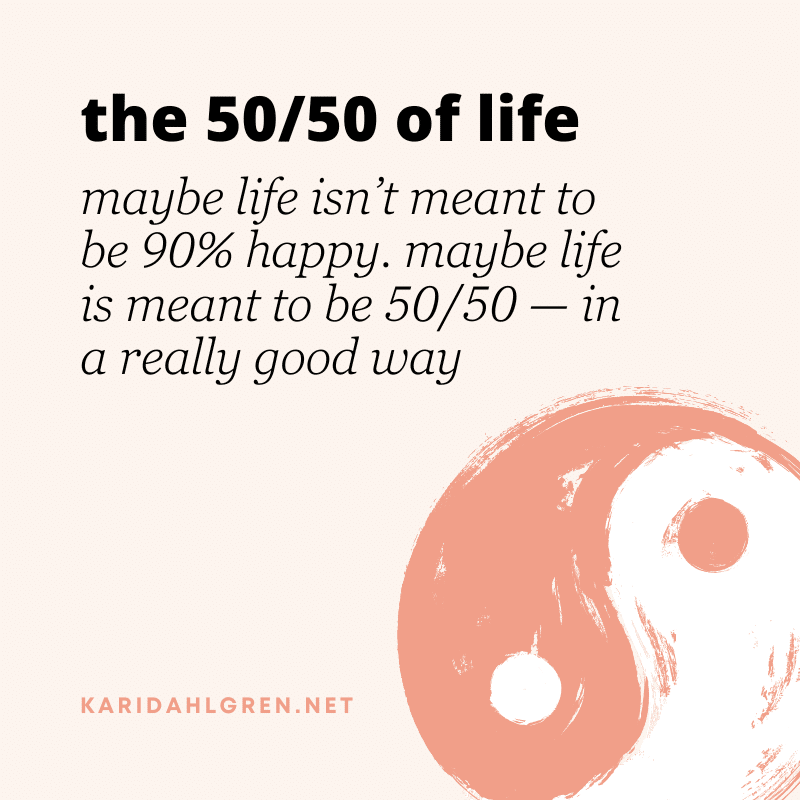
Many of us just want to be happy, so we chase thinness to hopefully get there, but this is an aimless goal. Life will always be 50/50 good and bad; happy and unhappy. When we insist that life be 100% happy—a pattern that psychologist Robert Leahy calls emotional perfectionism — it actually increases our unhappiness because we resist the bad even more. What’s worse: it also encourages overeating, and that certainly perpetuates unhappiness.
For me, life works much better when I set my expectations at 50/50. Then, when life is better than that, I feel great; and when life is dishing up what it often dishes up, I feel prepared at the very least. Though it never feels good to feel bad, I have developed patience for it—a skill that I call emotional tolerance — and that has dramatically contributed to my path of stopping overeating.
Are you ready for change?
I hope this post helped you rethink the idea that thinness = happiness. There’s a lot between Point A and Point B that the diet industry never encouraged us to consider. One of the best decisions of my life was giving up dieting and listening to my body instead.
It helped me finally feel less obsessed over food, and eventually create Psycho-Spiritual Wellness: a path to feeling normal around food that focuses on psychology and spirituality, not dieting.
If you’re curious to learn more about this strangely named approach to stop overeating, check out the free ebook below. It comes with a free 5-day course on Psycho-Spiritual Wellness—and it’s good stuff.


I read this 3 times to fully realize how true this is… I feel exactly like that woman you mentioned. This article will be my mantra from now! Thank you! 💕
Thank you so much Anna, it means a lot to me to know that this resonated. I can’t wait to see what unfolds for you with this new mantra!!! Keep me posted 🙂
Oh my goodness, how true this is. I’d been a member of a very popular weight loss program and achieved my goal weight. I am here to tell everyone that my life was not magically fixed by being “socially acceptably” thin. I still had all my other problems and I can honestly say that I did not achieve happiness. I am so glad that you point this out so beautifully. I never want to be lured in by all those false promises. I will be deliriously happy if I can shut off all the noise in my head regarding food and my body. I am so ready to dive into your workbook which I have and give that gift to myself. You are so awesome – thank you!
Hi Dolores!!! Thank you so much for such wonderful feedback!! Isn’t this epiphany such a liberating one?! I hope you send me an email with any thoughts and feedback once you get into the workbook. I would LOVE to hear how it goes!!!